You’re in the right place if you are thinking about reaching out for help, want to understand your options, or just want to know more about working with us. Here is a brief overview of what you can expect when you begin your journey with Stouffer Law.
Habeas Corpus in Immigration Detention: An Emergency Remedy
A phone call comes in late on a Tuesday. A husband doesn’t come home from work. By morning, his wife learns he has been transferred—possibly out of state—and no one will tell her how to reach him. The children keep asking when their father is coming home. The detention facility line either rings out or routes back to a recording. The family doesn’t have weeks to sort this out. They need a way into court as fast as possible.
That way exists. It is called a writ of habeas corpus, and for centuries it has been the legal tool that requires the government to bring a detained person before a judge and justify holding them. In immigration detention today, habeas is one of the most powerful remedies a family has. At this moment in U.S. history, it is being used more than ever before. Understanding when it applies, and when it doesn’t, can be the difference between a family stuck in silence and a family with a plan. It is always best to consult with a trusted immigration lawyer on these matters, and in this case, because of the severity and time-sensitivity of the situation, the family will need an urgent detention consultation.
Habeas corpus, in plain language
The Brennan Center for Justice describes habeas corpus as “a bedrock principle of constitutional democracy that protects against unlawful detention.” The phrase itself, from Latin, means “you should have the body.” In practice, that means a federal district court can order the government to physically produce a detained person and show, on the record, why holding them is legal. If the government cannot show legal authority for the detention, the court can order release.
In the immigration context, habeas does not decide whether someone has the right to remain in the United States. That question lives in the immigration courts. Habeas asks something different and more immediate: does the government have legal authority to keep this person in custody right now? The remedy a habeas petition seeks is also narrow (generally release, a bond hearing, or some other custody-related order) not a final decision on the underlying immigration case.
That distinction is important. A person can have a pending case in immigration court—even a difficult one — and still have a strong habeas claim if the rules governing their detention have been broken or ignored. The two tracks run side by side. The immigration case continues; the habeas petition addresses whether custody is lawful while it does.
A historic surge—and what the numbers mean for families
Habeas filings in immigration cases have climbed to historic levels. According to ProPublica’s habeas tracker, more than 18,000 immigration-related habeas petitions were filed in federal district courts between January 2025 and early February 2026. ProPublica’s analysis found that immigrants filed more habeas cases in the first 13 months of the second Trump administration than in the prior three administrations combined.
The volume is straining the federal district court system. As one Justice Department official told CBS News, “We never thought it would be a tsunami.” Across the country, U.S. Attorney’s Offices are pulling civil litigators off other matters to keep up with the wave of detention petitions.
The map of where these cases are filed is also revealing. Petitions are concentrated in states with large detention facilities and active enforcement operations: Texas and California lead by a wide margin, and Minnesota, despite a smaller overall immigrant population, now ranks third nationally. The geography of habeas reflects the geography of detention itself, and the federal districts hosting major facilities have become the front lines.
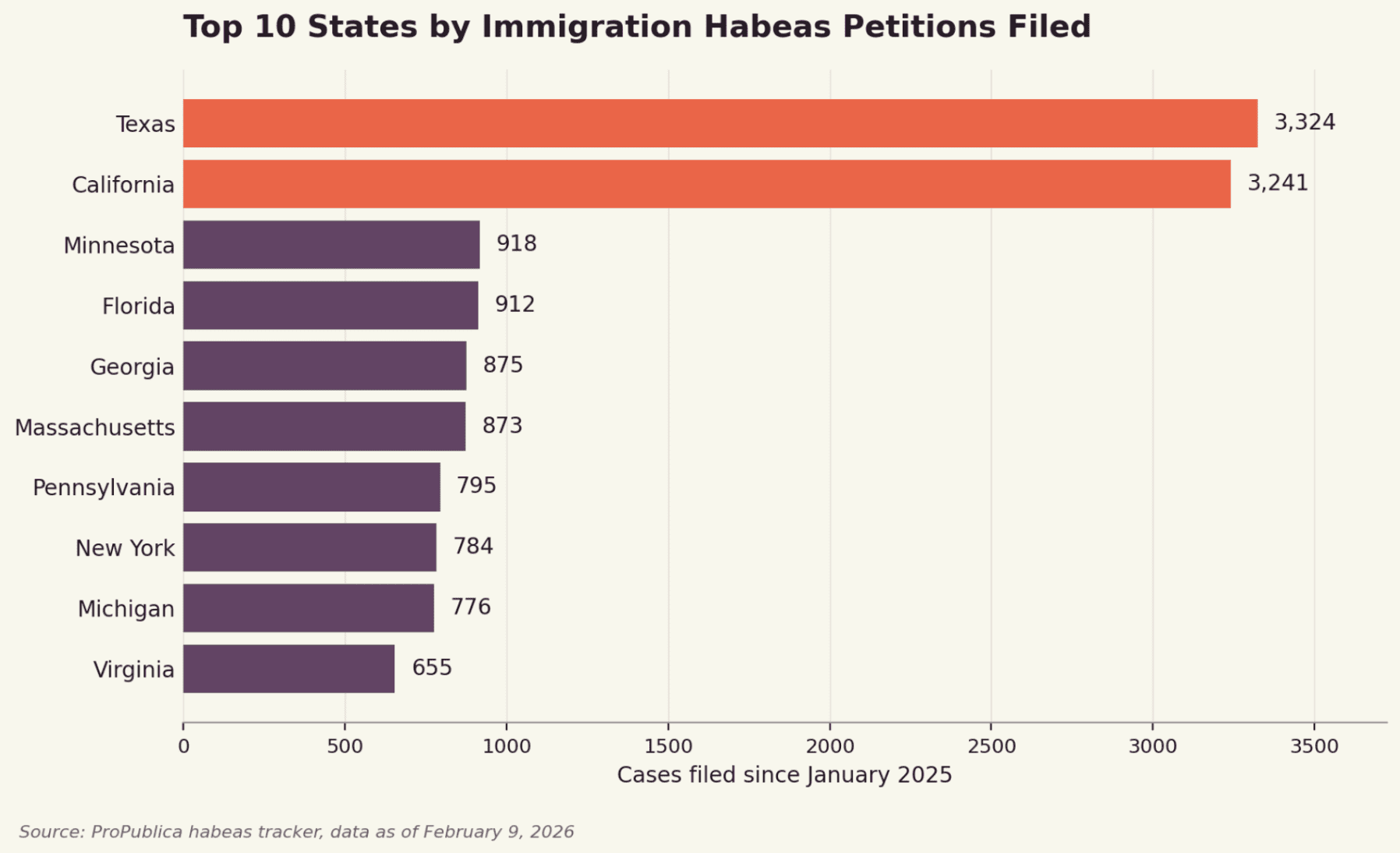
For families, those numbers translate to one reality: detention is happening fast, often without warning, and federal court is now central to challenging it.
When habeas is the right tool
At Stouffer Law, our federal litigation department accepts habeas petitions in several specific situations where the writ has the power to make a real difference. From their first urgent detention consultation, we walk with clients through these moments—calmly, clearly, and with the full team behind them.
We assist clients with the following issues:
Prolonged detention without meaningful review. Under the Supreme Court’s decision in Zadvydas v. Davis, the government cannot detain someone indefinitely after a final removal order if there is no significant likelihood of removal in the reasonably foreseeable future. Six months of post-order detention is the presumptive limit. We file habeas petitions for clients held past the point that Zadvydas and related precedent allow, particularly when removal is blocked by stateless status, lack of a receiving country, or other circumstances unlikely to resolve.
Post-order re-detention. Federal regulations—including 8 C.F.R. § 241.4 and § 241.13—set out the procedures and standards that Immigration and Customs Enforcement (ICE) must follow when seeking to re-detain someone after a final order of removal. These rules protect people who have been released under supervision from being re-detained without process. When those procedures are skipped or misapplied, habeas is the way to challenge the re-detention and seek a return to release.
Pre-removal-order detention. People in detention before a final order of removal also have rights. We file habeas petitions challenging detention during ongoing immigration proceedings when the legal basis for custody is missing, has lapsed, or rests on a misreading of the applied statute. These cases are often time-sensitive, because the underlying immigration case is also moving.
Transfers that cut off access to counsel. When ICE transfers a detained person far from their attorney—sometimes across state lines, sometimes overnight—the move can effectively block them from their legal team at the moment they need it most. Federal district courts can address transfers that interfere with the right to counsel, including by ordering the person’s return or by halting an imminent transfer before it disrupts an active case.
Detention of unaccompanied children. Children held by the Office of Refugee Resettlement (ORR) have rights too. Children’s detention raises distinct legal and human concerns, and the standards for custody and placement are governed by their own framework. We accept habeas petitions challenging the detention of unaccompanied children when the circumstances warrant federal court intervention.
What happens when you call us
When a family reaches us about a detention emergency, the emergency detention consultation is about getting clear on a few specific things—quickly, calmly, and in plain language.
We want to know things like: Where is the detained person being held, and under what authority? How long have they been in custody? Are there pending immigration proceedings, and at what stage? Has there been a bond hearing, and if so, what was the outcome? Are there transfer concerns, including any active threat of transfer out of district? What records does the family already have, and what records do we need to request right away?
From there, we can usually tell within a single consultation whether habeas is the right tool, whether another remedy fits better, or whether the case calls for a referral. If habeas is the right path, we move quickly. Federal litigation timelines are short by nature, and a well-prepared petition can be filed within days when the facts are clear and the documentation is in hand.
Detention cases are not handled by a single attorney working alone. The full team is built around a case from the start: federal litigation counsel, immigration counsel, paralegals, and bilingual support staff who can communicate clearly with family members in English or Spanish. That collaborative structure matters in an emergency. There is no single point of failure, no waiting for one person to be free, and no need for a family to repeat their story from the beginning every time they call.
Courage to take the first step
Detention is one of the most disorienting moments a person and family can face. The system is fast. The stakes are extremely high. And it is easy to feel, in the early hours, that no one is on the other end of the phone.
Habeas corpus exists because the people who shaped our laws understood the most basic protection a society owes its members: when the government holds you, a judge can be asked, and answer, why. That principle is older than the Constitution that enshrines it, and it remains one of the strongest tools available today.
It takes courage to take the first step. We are here for you when you do.
If a loved one has been detained and you need to understand your options, call Stouffer Law for an urgent detention consultation.
Accreditations





Contact us today.
"*" indicates required fields