Está en el lugar correcto si está pensando en buscar ayuda, desea entender sus opciones o simplemente quiere saber más sobre cómo es trabajar con nosotros. A continuación, le ofrecemos un breve resumen de lo que puede esperar al comenzar su camino con Stouffer Law.
Why Administrative Delay Is a Pattern, Not an Accident, and What You Can Do About It
You filed everything on time with U.S. Citizenship and Immigration Services (USCIS). You answered the request for evidence. You sent in the updated tax return, the new medical exam, the second set of biometrics. Then the line went quiet. Months passed. A year. You started checking your case status before you even checked the news. And somewhere in the back of your mind, you began running a quieter question: did I miss something?
We hear that question from clients, in some form, more and more often. It can come from someone whose case looks straightforward on paper—a marriage-based green card, an N-400 sitting past its interview date, an I-140 caught in adjustment limbo. It’s normal to ask: did I or we do something wrong? Almost always, you haven’t. The USCIS processing delays are systemic. Knowing that does not make the wait less painful, but it does change what you can do about it.
The system itself is overloaded
The clearest window into how strained the immigration system has become is not a USCIS press release. It is noting federal court dockets.
In Minnesota earlier this year, the U.S. Attorney for the District filed a brief telling the court that immigration filings have left his office in “reactive mode.” His civil division is down 50%. Lawyers and paralegals are working overtime. One Justice Department official, speaking anonymously to CBS News, described the surge of cases this way: “We never thought it would be a tsunami.”
Most of those filings are habeas petitions—challenges from people in immigration detention asking a federal court to review whether their detention is lawful. That is a different track from a delayed green card. But the strain at the U.S. Attorney’s offices that defend the federal government in these cases is a window into the wider system which governs the whole country. Every part of the immigration apparatus, from USCIS officers adjudicating petitions to government lawyers responding to court filings, is operating well past designed capacity.
When a system is past capacity, ordinary cases get slower.
The numbers tell a pattern
ProPublica has been tracking immigration-related habeas filings since the start of 2025. The cumulative count, as of early February 2026, is over 18,000 cases. According to ProPublica’s analysis, immigrants filed more habeas cases in the first 13 months of the second Trump administration than in the past three administrations combined.
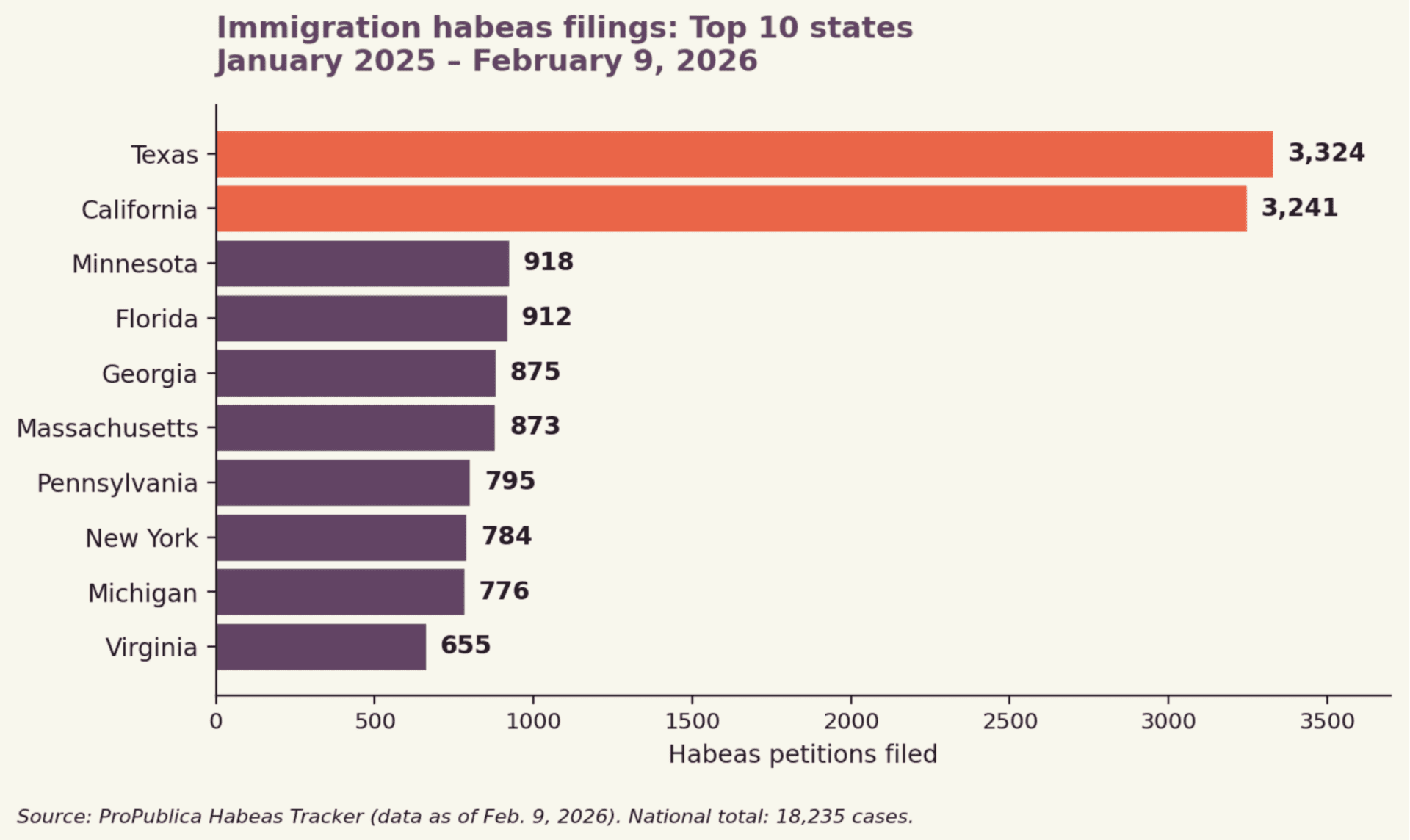
The geography matters. The states leading the count—Texas, California, Minnesota, Florida, Georgia—are also the states with the largest detention facilities and the most active enforcement operations. The pattern of delay and dispute follows the pattern of enforcement.
For someone whose case is not about detention—whose case is about an adjustment-of-status application that has gone two years without an interview—these numbers are still important. They are evidence that federal district courts have become the place the immigration system goes when it cannot resolve its own backlog.
The pattern is documented in court
If administrative delays were just bad luck, you would expect federal judges to say so. They have not.
In Nightingale v. USCIS, a class action brought by the American Immigration Council and partner organizations, a federal court in San Francisco found that USCIS and ICE had a systemic pattern and practice of failing to provide immigrants with their own immigration files within the deadlines Congress set in the Freedom of Information Act. By the end of fiscal year 2018, USCIS reported a backlog of more than 41,000 pending requests for these files alone. The court rejected the agencies’ argument that volume alone explained the problem and ordered a comprehensive remedy that the judge described as long overdue.
That ruling was years ago. It did not solve the underlying problem. A whistleblower disclosure published in late 2025 alleged that USCIS adopted internal practices designed to reject FOIA requests outright, lowering the number of cases on the books rather than processing them faster.
This is the part most clients never hear. The delays you are experiencing did not begin with your case. A federal judge already said the agencies are violating the law. The problem is older than your application, and the courts have already named it.
A new layer of delay arrived in April, 2026
On April 27, 2026, USCIS implemented a new “enhanced” background-check requirement for immigration applicants. Internal guidance, first reported by CBS News and confirmed by Reuters, directed USCIS officers to refrain from approving any pending case that has not undergone the expanded check. Officers were also told to resubmit fingerprints for cases where FBI information had been received before April 27.
A USCIS spokesman said “any delay in decision issuance should be brief and resolved shortly.” But that assurance is hard to square with what the agency is actually being asked to do: layer a new vetting process on top of an already-strained adjudication pipeline, while pulling officers away from approvals to reprocess cases that had already cleared earlier checks.
For people in the middle of the process—a green card adjustment, a naturalization application, a work-authorization renewal tied to a delayed underlying case—this means another wait inside the delay. Not because of anything in your file but because of where your file is sitting.
Federal district court is a real option
When agency delay crosses from frustrating into unreasonable, federal district court is the legal path forward. A mandamus action does not ask a federal judge to grant your petition. It asks the court to compel USCIS to do its job, to make a decision on a case that has been pending past the point the law allows.
The cases that fit this remedy are more common than people realize. They include: an adjustment-of-status application with USCIS delayed for eighteen months past the published processing time; an N-400 stalled more than 120 days after the naturalization interview; an I-130 or I-140 that has gone silent for years with no request for evidence and no decision; an I-765 employment authorization renewal where the underlying case is the bottleneck. None of these is a difficult case in the legal sense. They are cases where the agency has simply not acted.
Our strategy is always specific to the facts. It depends on the type of application, the published processing times, what has been submitted, and what is actually causing the delay. Sometimes the right answer is to wait a little longer. Sometimes the right answer is that we could have filed last month. Either way, you deserve to know which one applies to you.
What we want clients to understand is this: when administrative delay is a pattern, the question stops being “what did I do wrong.” The question becomes “what tool fits this moment.” For a long-stalled application, that tool is often a federal district court filing.
Take the next step
It takes courage to stop waiting and start asking a different question. If your case has been pending past published processing times, if your N-400 has sat more than 120 days after your interview, if your adjustment of status has gone quiet for a year or more—there may be a path forward.
If you feel that question matters to you, book a federal litigation consultation We will look closely at where your case actually stands, explain in plain language what a federal filing can and cannot do, and tell you honestly whether this is the right path for you. The pattern of delay is not your fault. The next move can still be yours.
Acreditaciones





Contáctenos hoy.
"*" indicates required fields